Class 1 exotic wood lasts outdoors for many years, with no lacquer and no stain. The real lifespan depends on the species, on the installation and on the maintenance, not on a finish.
This article explains why oak is not suitable for an exposed deck, what the grey patina means, which fixing systems exist and what to write in the specification.
A case from the field
We recently received a quotation request for an outdoor deck, in a public location in Romania. The specification called for a solid oak deck, boards of 40×120×3,000 mm, pressure-treated, over several thousand square metres.
The specification looked premium, because oak is a noble wood. On a technical analysis, the problem appears outdoors, not in the quality of the wood.
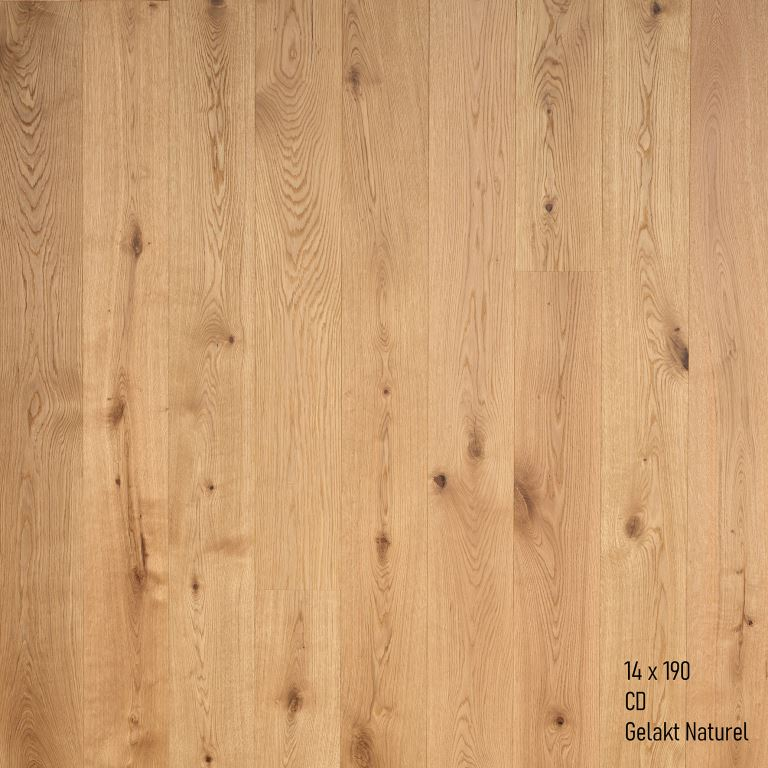
Why oak is not suitable for an outdoor deck
European oak has natural durability class 2 under EN 350. For a permanently exposed deck, the realistic threshold is class 1, specific to tropical species. The typical problems are:
- ◆Tannins stain stone, concrete and drainage elements, and the stains are hard to remove.
- ◆Solid 40 mm boards move with the wetting and drying cycles: cupping, twisting and cracks appear.
- ◆Pressure treatment penetrates little into the dense heartwood of oak and solves neither the tannins nor the stability.
- ◆Knot-free boards with straight grain, in large quantities, are hard to find, and the price ends up above that of class 1 exotic wood.
Class 1 exotic wood protects itself
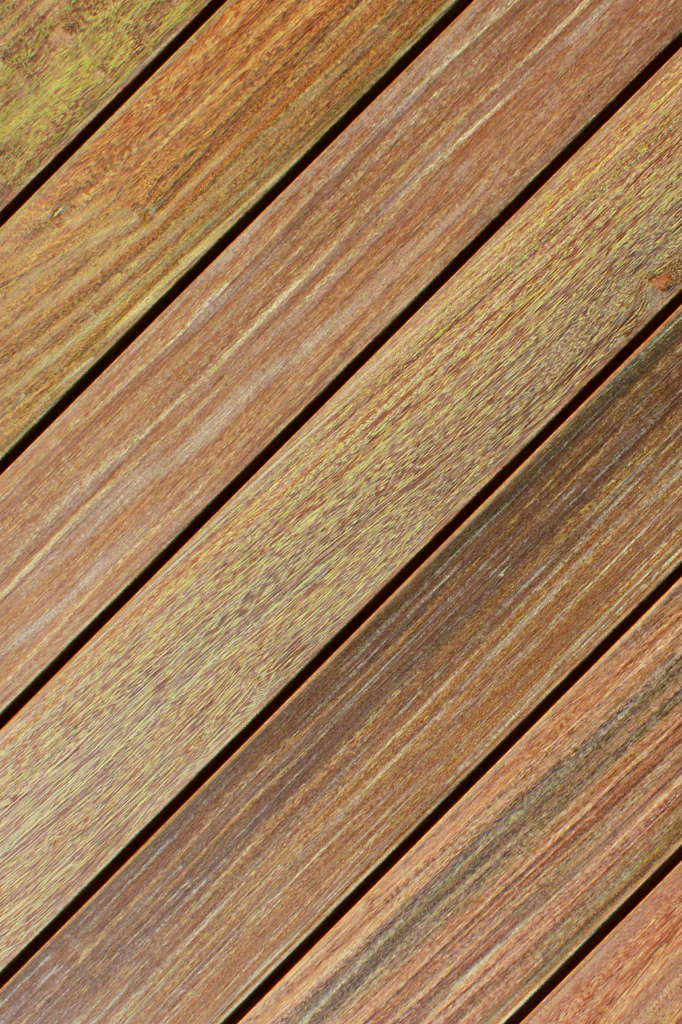
Teak, ipé, padauk or merbau have high density and natural oils, so they protect the wood themselves. They need no coat of lacquer or stain.
Lacquer and film-forming stain on a deck fade and peel, and the remedy requires sanding. Sanding opens the pores of the wood and can trigger exactly the cracks you wanted to prevent.
In the long term, durability depends on the installation: joints, ventilation and expansion gaps respected.

The myth of the obligatory finish
Many people believe outdoor wood must always be painted or lacquered. For treated local wood, that is true. For an exotic deck, it is not.
If you want to keep the warm tone, there are coloured oils for decks, applied every 6–12 months. It is an aesthetic choice, not a condition of protection. For oil, from our range: Bona Decking Oil. For cleaning: Bona Outdoor Wood Deck Reviver. The full steps are in the deck maintenance guide.
If you have already heard that exotic wood “must be oiled no matter what”, also read the article about this myth.

The grey-silver patina: three strategies
Wood exposed to the sun changes colour. The pigment oxidises at the surface and, within months or years, the deck goes from the warm tone to a grey-silver patina. It is an aesthetic process, at the level of millimetres at the surface, which does not affect the structure.
You choose one of the three options:
- ◆You let the wood silver. The grey patina blends with stone, concrete and metal, and maintenance is limited to periodic washing.
- ◆You wash periodically with a pad and a detergent for exotic decking. This removes the surface oxidation and partly restores the light brown tone, without sanding.
- ◆You apply an oil with UV pigments, on the clean surface, every 6–12 months. It slows the silvering, but it is a repeated treatment, not permanent protection.

Exposure zones: not all of a deck works the same way
- ◆Horizontal. The deck gets wet directly, holds water in the joints and receives solar radiation at the maximum angle. For this reason, on a deck the class 1 species and the installation system are compulsory, not optional.
- ◆South or north. South-facing areas silver faster and more unevenly. Shaded areas stay damp for longer and need cleaning for moss and algae.
- ◆Next to water. A pool adds chlorine, and coastal areas add salt. The class 1 species and the aluminium structure must be sized for these conditions.
- ◆Steps and ramps. This is where the safety requirements concentrate, and therefore so does the anti-slip solution (see below).


What to choose, by criteria
The table compares the usual types of deck by qualitative criteria. It is indicative: confirm the figures for each product with the technical data sheet.
| Criterion | Class 1 exotic wood with invisible fixings | Treated local wood | Heat-treated wood | Stone or ceramic cladding | WPC |
|---|---|---|---|---|---|
| Natural durability | High (class 1) | Medium, depends on the treatment | Medium to high | Very high, the support system must be checked | Medium, depends on the model |
| Colour over time | Silver patina, partly reversible by washing | Fades, the film peels | Silvers | Stable | Fades, depends on the model |
| Maintenance | Washing, optional oil | Periodic repainting | Washing, optional oil | Cleaning the joints | Periodic washing |
| Comfort underfoot | Warm, no splinters | Splinters with wear | Softer | Cold, hard in a fall | Variable |
| Slip resistance | Smooth surface, integrated strips where needed | Decreases with the film | Good when dry | Smooth, slippery when wet | Variable |
| Repair | Board by board | Local, with difficulty | Board by board | Difficult | Difficult |


The Vetedy InfinYdeck system: what the manufacturer says

Vetedy is a family company founded in 1999, based in Luxembourg with production in Belgium. The manufacturer presented InfinYdeck at the factory on 20 November 2025, as an invisible fixing system on an aluminium structure.
What the manufacturer says about the system:
- ◆The reinforced polymer clips are mounted on the aluminium joist, with no holes or screws on the surface.
- ◆The integrated spacer ensures even joints, with no repeated measuring.
- ◆Fast fixing on Buzon pedestals and a 45° connection for borders and steps.
- ◆The structure and the clips were tested for static and dynamic loads, for freeze–thaw cycles and for UV, a testing the manufacturer describes as covering more than 25 years of exposure.
Vetedy gives a 25-year warranty for the InfinYdeck system.


InfinYdeck 140 mm: technical data
| Characteristic | Value |
|---|---|
| Board | 140 mm width, 20–21 mm thickness; visible face smooth, grade 1 |
| Lengths | 800–2800 mm, in a mix of lengths |
| Lambourde | Aluminium profile 6063-T5, with 16 thermoplastic polyamide clips at 140 mm |
| Maximum load | 250 kg/m², in private and public locations |
| Installation temperature | +5 °C to +45 °C |
| Service temperature | −30 °C to +60 °C |
| Marine environments | Permitted, with conditions (consult the manufacturer) |
| Indicative consumption | 6.82 linear metres of board per m², with no site losses |
| Species in the system | Merbau, Kebony Clear, Accoya Natural and Grey, thermo ash, bamboo, Melywood |
| Patent | LU601851 (mentioned in the technical data sheet) |
| Maintenance | The high-pressure cleaner must not be used |
Slip resistance: a smooth surface and strips where needed
On the field, a smooth surface performs better than a grooved one. Grooves collect water, dust and leaves, and over time they turn an anti-slip surface into a slippery one.
On steps and ramps, the safety requirements are higher. Vetedy anti-slip strips are certified R11 (DIN 51130). Some systems have strips integrated into the board; check, for the system you choose, the warranty conditions for the strip.
The cost over the lifetime
A cheap deck, installed today and replaced a few years later, often ends up being paid for two or three times: material, dismantling and replacement. The right material is paid for once.
With invisible fixing systems, a damaged board can be replaced without dismantling the rest of the terrace. The exact figures depend on the project, so we calculate them in the quotation.
Solid wood is renewable. Plastic composites combine wood fibres with polymers and are hard to recover at the end of their life.
For architects: what to write in the specification
- ◆A species with class 1 durability (EN 350), mentioned explicitly, not just the commercial name.
- ◆A selection with no large knots and with predominantly straight grain.
- ◆An invisible fixing system on an aluminium structure, with defined joints and expansion gaps. For raised terraces, compatibility with adjustable pedestals.
- ◆Slip resistance: a smooth surface on the field and certified strips on steps and ramps, if the project requires them.
- ◆Maintenance: washing with a dedicated detergent and, optionally, a coloured oil. No lacquer or film-forming stain.
- ◆Written warranties from the manufacturer, for the wood and for the system.
Frequently asked questions
Does exotic wood withstand Romanian winters?
Class 1 species and aluminium-structure systems are tested, according to the manufacturers, for freeze–thaw cycles. Real durability depends on the installation.
Does an exotic wood deck need to be painted or oiled?
No. The protection comes from the natural durability of the species. Coloured oil is optional, every 6–12 months.
Why does the wood turn silver? Does it mean it is degrading?
No. Silvering is surface oxidation under UV. It does not affect the structure and can be partly restored by washing.
How long does an exotic wood deck last?
It depends on the species, the installation, the ventilation and the maintenance. Check the manufacturer's written warranty.
Why is oak not recommended for outdoors?
Its natural durability is below class 1, tannins stain stone, and solid boards move with moisture. Details in the section above.
Conclusion
For a permanently exposed deck, class 1 exotic wood and an invisible fixing system are the safest combination. The species provides durability, the installation provides stability, and maintenance stays simple.
If you want to see the materials before deciding, come to the showrooms in Bucharest and Cluj-Napoca. For a deck on a project, ask for a quotation: prices and lead times are confirmed separately, for each project.